
Capacity planning means having the right number of technicians with the right skills available at the right time for incoming jobs. The steps: assess your current capacity, set goals, build a subcontractor network, understand demand, and keep monitoring and fine-tuning.
In service and maintenance, capacity planning is one of the most important conditions for staying competitive and delivering a good customer experience. It's not just about handling today's demand but about forecasting and planning for tomorrow's.
Capacity planning means using people and materials efficiently. In field service, that means the right number of technicians with the right skills being available on time. It's a fine balance between supply and demand that takes deliberate workforce management, resource allocation and scheduling.
Field service management (FSM) software plays an important role in capacity planning, but on its own it isn't enough. Let's look at what else to pay attention to.
Assess your current capacity
Assess your team's capabilities: the number of technicians, their skills and their availability. This assessment is the foundation of capacity planning.
Set goals
Define clearly what you want to achieve. Whether it's shorter response times, a higher first-time fix rate or happier customers, clear goals give you direction.
Build a subcontractor network
Not every job can or should be done in-house. Some tasks come up rarely or need special skills, so it doesn't make sense to keep your own staff for them. For those cases, always have two or three reliable subcontractors on hand.
Stay in touch even when you have no joint work, so you have someone to count on when a job like that comes up again.
Understand demand
It's important to see how demand develops in your industry.
Is it seasonal? For an HVAC-R company the busiest time is summer, so it's worth booking subcontractors early to be able to cover every job.
What economic factors affect demand? Are rebates or incentive programs expected that will boost demand? Prepare so that you have enough well-trained sales staff and technicians to meet it.
Monitor and fine-tune
Capacity planning is an ongoing task. Review performance and goals regularly and adjust your plan as needed. The reports in your FSM software help you spot where changes are needed.
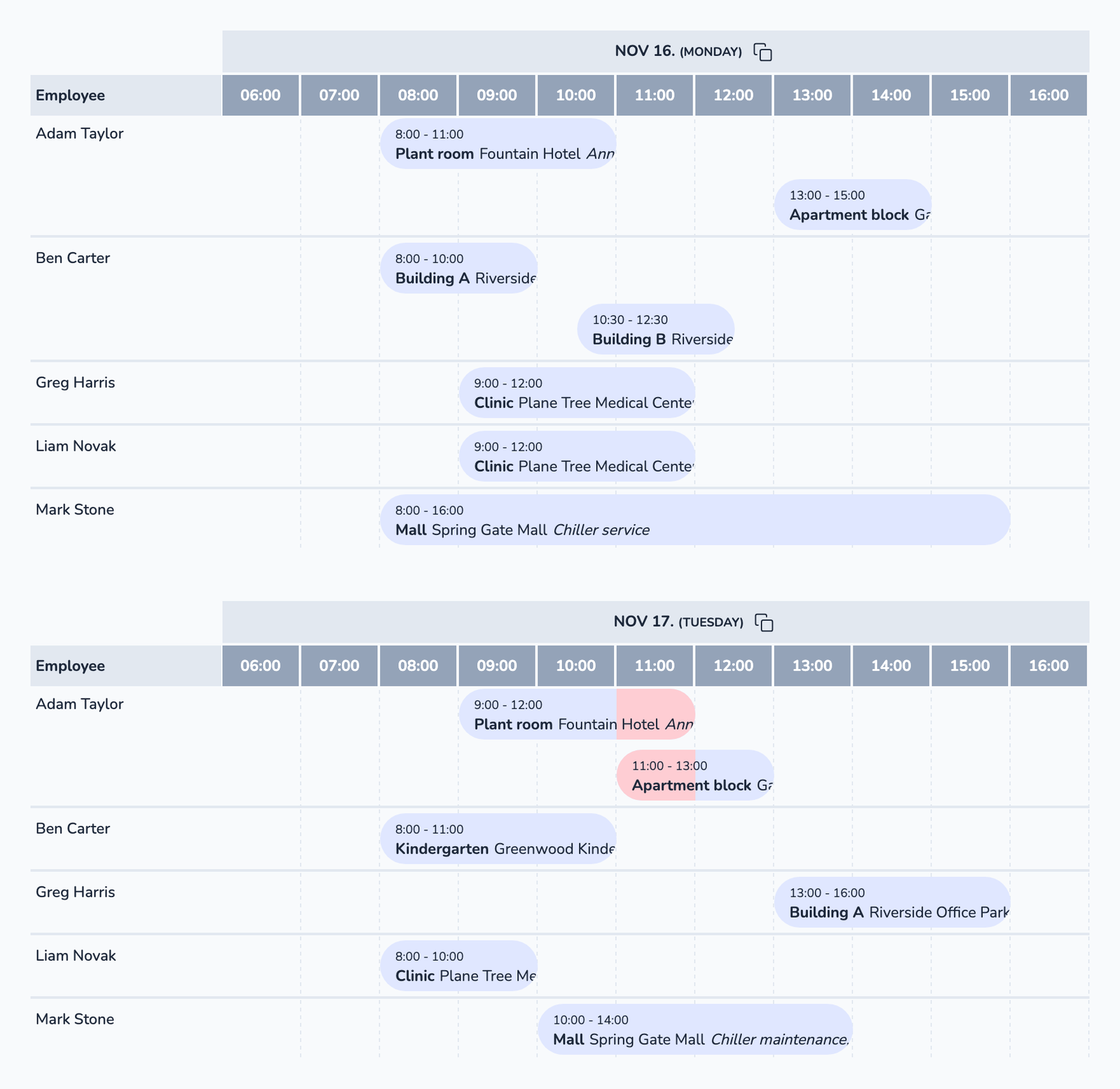
A Gantt chart helps you plan resources, spot idle time and avoid conflicts.
Real-time data
Field service software gives you a real-time view of your team's availability, skills and current jobs. That transparency is key to fast, informed decisions, especially when things change unexpectedly.
Dynamic scheduling
Modern software can use artificial intelligence to dynamically and automatically assign the best-suited technician based on availability and skills. That cuts travel time and cost and helps maintain service quality.
Demand forecasting
Advanced FSM solutions forecast the number of expected service requests based on historical data, seasonality and other factors, so you can plan resources and workload ahead of time.
More efficient admin
By automating scheduling, travel and other administrative tasks, service management software frees up valuable time for your team. That improves not only productivity but also service quality.
For other features worth looking for in FSM software, see this article.
If you'd like to see how FSM software can help your business, or want to try Kompozit, request a free demo.
Capacity planning means having the right number of technicians with the right skills available at the right time for incoming jobs. It covers assessing current capacity, forecasting demand and seasonality, bringing in subcontractors and continuously fine-tuning the schedule.
Look at previous years' data to see when job volume rises, for example in summer for HVAC-R. Book subcontractors before the peak, schedule routine maintenance for quieter months, and watch technician workload so you can rebalance jobs in time.
In FSM software you see in one place who is working when and where. Kompozit flags when a technician is booked for two jobs at once, the capacity report shows the team's workload, and recurring jobs and maintenance reminders make the coming weeks' work visible in advance.
When a task comes up rarely or needs special skills, and during seasonal peaks. Keep in touch with two or three reliable subcontractors and track their work in the same system as your own team's, so billing is accurate too.
